Materials
Choosing Watercolor Brushes
Pick watercolor brushes by hair and shape: sable, squirrel and synthetic, round, flat, mop and rigger, plus size, snap, point and how to care for them.
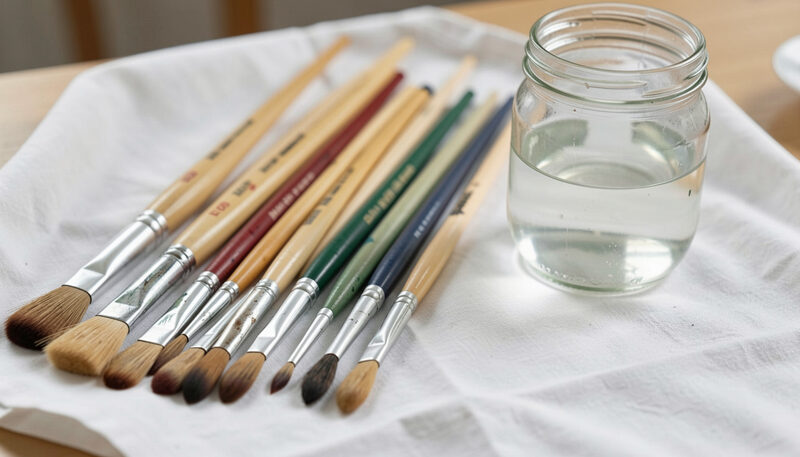
A brush carries water and pigment to the paper, and it is the painter's hand in the most literal sense. Watercolor brushes differ from other painting brushes in how much water they hold and how well they come to a point. A good watercolor brush holds a reservoir of water in its belly, releases it evenly, springs back into shape, and finishes in a fine point. Understanding hair, shape and size is what separates a useful brush from an expensive mistake.
What a brush has to do
Three qualities matter. The first is water capacity: a brush that holds a lot of water lets a large wash be laid without reloading. The second is snap, the ability of the hairs to spring back after being pressed to the paper; snap gives control over the mark. The third is the point, the tip that gathers the hairs together so a single brush can make both a broad wash and a fine line. A brush that fails on any of these will frustrate the painter, whatever it costs.
Hair: sable, squirrel and synthetic
Kolinsky sable is the traditional best, with a fine point, excellent snap and a large water capacity, and it is priced accordingly. Squirrel hair is softer and holds even more water, which makes it ideal for large wet washes and skies, but it has little snap and does not point sharply. Synthetic hair, often a blend of polyester filaments, has improved greatly and now offers a firm point and good snap at a low price, which makes it the sensible first choice for most painters. Natural and synthetic hairs can also be blended in one brush to combine capacity and snap.
Shapes and what each is for
A round brush points to a tip and holds water in the belly; it is the workhorse, used for lines, small shapes and washes alike. A flat brush has a square end and is used for blocks of color, clean edges and dry brush texture. A mop or wash brush is large and round, made for laying wide areas of water and color quickly. A rigger or liner is long and thin, for fine lines such as branches, wires and boat rigging. A fan brush is used for grass and foliage texture. Most painters need a round, a flat and a large wash brush, and add the others only when a subject calls for them.
Size and how few you need
Brush sizes are numbered, but the numbers are not consistent between makers, so the physical size is what matters. A single large round, around size 12 to 16, can paint most of a medium watercolor, including fine lines, because a good brush points. Adding one smaller round for detail and one flat for edges is usually enough to begin. It is better to own two or three good brushes than a set of ten poor ones, because the good brush does the work of several.
Snap, point and belly in practice
To test a brush, wet it and roll the tip on a scrap of paper. It should come to a clean point and spring back when pressed. Dip it in water and draw a long line; the line should be even and should last across the page. Press the belly flat and pull; a good brush releases water smoothly rather than dumping it. These simple tests tell more than a price tag, and they can be done in a shop with a cup of water.
Care and storage
Rinse a brush in clean water after every session and reshape the point with the fingers. Never leave a brush standing in water, which bends the hairs and loosens the ferrule. Dry brushes flat or standing on the handle end, never on the hair. Store them in a roll or a jar so the points are protected. With this care a good brush lasts for years and improves with use, because the hairs soften and the point becomes more responsive.
Choosing a first brush
A beginner is best served by one large synthetic round, around size 12, and one medium round around size 6, both with a good point. A large round will lay a wash, and, because it points, it will also paint a fine line, which surprises painters who assume a big brush is only for big areas. Adding a one-inch flat later gives clean edges and dry brush. Buying a numbered set of ten brushes is a waste, because most of them will never be used and their quality is often poor. Two good brushes teach more than ten cheap ones.
The marks a brush makes
Each part of the brush makes a different mark. The point draws a fine line and a small shape. The belly, pressed down, lays a broad wash and releases water steadily. The side of a round or flat brush, dragged across dry paper, leaves the broken texture of dry brush. The heel of the brush, near the ferrule, makes a wider, softer stroke. Learning to roll the brush between the fingers to change from point to belly, and to lift at the end of a stroke to make a taper, gives a painter a whole vocabulary of marks from a single tool.
Travel brushes and the outdoor kit
For painting outdoors, a travel brush with a cap that becomes the handle is convenient and protects the hair in a bag. A small round, a medium flat and a water brush, which holds water in the handle, cover most outdoor subjects. The sketchbook guide describes a light kit for painting on the spot, and the materials section sets brushes beside paper and pigments. With the right few brushes, the technique guides become much easier to practice.
A round brush of moderate size, held lightly near the ferrule, can lay a wash, lift a highlight and draw a line without changing tools. That economy matters when the subject will not hold still: a player mid-pass, a musician at the piano, a speaker at the podium. Shape and size decide how much can be said before the moment closes. For painters who want to work at that speed, one brush for quick sketches is the practical starting point, and the magazine's guide to a sketchbook kept through the school year follows the idea from there.
Hair, shape and size decide how a brush behaves, but a beginner needs only two: a round that springs back to a sharp tip and a flat wide enough for a wash. Everything else can wait until the hand knows what it is missing. A round in the middle sizes, somewhere near a number 8 or 10, covers lines, small shapes and soft edges; a one-inch flat handles skies and broad passages of color. Two brushes, a folding palette, a pad of cold press paper and a simple weekly routine are the whole of a first kit, and the cost stays modest. For the full list, see a brush that holds a point.