Materials
Watercolor Paper Sizes and Which Side to Paint On
Full, half and quarter imperial sheets, A-series pads, why pound weight depends on size, and how to find the felt side of a sheet before the first wash.
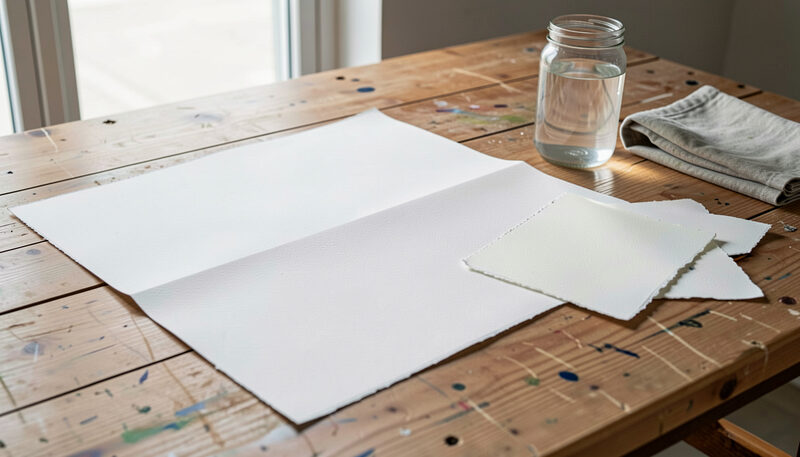
The standard sheet of watercolor paper is the imperial, 22 by 30 inches or about 560 by 760 millimeters, and most studio sizes come from folding it: a half sheet is 15 by 22 inches, a quarter sheet 11 by 15. Pads usually follow the A series instead, from A5 to A3. As for the side, both faces of a good artist paper can be painted, but the felt side, which mills such as St Cuthberts pack uppermost, is the face many artists prefer.
Those two questions, how big and which way up, come before the first wash, and they are less obvious than they look. A painter who buys a full sheet with no plan for cutting it, or who spends an afternoon on the wire-marked back of a sheet without knowing it, learns the hard way. This guide sets out the sizes in use, how to choose among them for a given project, why the weight printed on the label changes with the format, and how to read a sheet before the first stroke.
What are the standard watercolor paper sizes?
Loose sheets of artist paper are still sold in an old British size, the imperial. St Cuthberts Mill, the English maker of Saunders Waterford, gives it as 560 by 760 millimeters, or 22 by 30 inches, and the French mill Arches lists its Aquarelle sheets at 56 by 76 centimeters. Painters rarely work on the whole thing. They speak of half sheets and quarter sheets, which are simply the imperial folded and cut, and the arithmetic stays tidy: each cut halves the long side.
Larger and smaller formats sit alongside. A double elephant sheet measures about 26 by 40 inches, the exact width varying a little from one mill to another. Pads sold in Europe and much of the world follow the ISO 216 A series, in which A4 is 210 by 297 millimeters and each step up doubles the area. Arches, for example, sells blocks glued on four sides from 10 by 25 centimeters up to 46 by 61, and pads glued on the short side from A5 to A3.
| Format | Inches | Millimeters | Typical use |
|---|---|---|---|
| Double elephant | about 26 x 40 | about 660 x 1020 | Large studio work |
| Full sheet (imperial) | 22 x 30 | 560 x 760 | Wide landscapes, or cut down |
| Half sheet | 15 x 22 | 380 x 560 | A finished studio painting |
| Quarter sheet | 11 x 15 | 280 x 380 | Studies and single subjects |
| Eighth sheet | 7.5 x 11 | 190 x 280 | Color tests and value sketches |
| A3 pad | 11.7 x 16.5 | 297 x 420 | Larger studies on a pad |
| A4 pad | 8.3 x 11.7 | 210 x 297 | Desk practice, a bag |
| A5 pad | 5.8 x 8.3 | 148 x 210 | Pocket sketching |
How do you choose the right size for a project?
The size follows the subject, the brush and the time available, roughly in that order. A broad landscape with a big sky wants room for a large brush to travel, and a half sheet gives a wide flat or a mop enough distance to lay a graded wash across the whole picture. A single flower, a doorway or a portrait study sits comfortably on a quarter sheet. A color test or a value sketch needs no more than an eighth.
Time matters as much as subject. A wash across a half sheet takes several minutes to lay and longer to dry, and a beginner can lose control of the wet edge before reaching the far side. That is the case for starting on quarter sheets: the whole painting stays in view, the water stays manageable, and four attempts come out of one imperial sheet. Outdoors, a small block in a bag is easier to manage than a board and clips, and the guide to painting outdoors from a sketchbook describes that lighter kit.
Framing is the last test. A painter who plans to frame the work can decide the size of the image first, leave a margin on every side for tape and mat, and only then choose the sheet. Working backward from the frame avoids the common disappointment of a painting that is a few centimeters too large for any mat in the shop.
Why does the weight on the label change with the size?
Watercolor paper thickness is described by weight, and two systems are in use. Grams per square meter, written gsm or g/m², is the weight of one square meter of the paper, so it stays the same whatever the size of the sheet. Pounds, the older measure still common in the United States, give the weight of a ream of 500 sheets at the size being described. St Cuthberts Mill spells out the consequence: the same 300 gsm paper counts as 140 lb at 560 by 760 millimeters, but as 70 lb at 560 by 380.
That is why 140 lb appears on so many labels: it is a 300 gsm paper measured at imperial size, and the pound figure is best read as a name for the paper's thickness rather than the weight of the pad in hand. Arches lists its Aquarelle range at 185 gsm (90 lb), 300 gsm (140 lb), 356 gsm, 640 gsm (300 lb) and 850 gsm (400 lb). When comparing papers from different makers, the gsm figure is the reliable one.
Weight also decides how a sheet behaves under water. St Cuthberts Mill notes that a heavy paper of 425 gsm (200 lb) and above stays stable when water is added, while lighter sheets are usually soaked and taped to a board first; the mill suggests about three minutes of soaking for a 190 gsm sheet and about eight for a 300 gsm one, then gummed tape with at least a centimeter on the paper and a centimeter on the board, since masking tape will not hold. How weight works together with fiber, sizing and surface is set out in the main paper guide.
Which side of watercolor paper should you paint on?
Both sides of a good artist paper can be painted. St Cuthberts Mill says so directly, adds that its papermakers try to make the two faces as alike as possible, and treats the choice as a matter of preference. There is still a front. The top of the sheet as it is made is called the felt side, because it is the face that first touches the wool felt that carries the wet sheet away from the mould. Its texture is the more random of the two, and the mill describes it as the side many artists consider superior.
The underside is the mould side, the face that lay against the wire mesh of the cylinder mould. On close inspection its texture is a little more regular, because traces of the mesh remain. On paper made on a Fourdrinier machine, the same pair of faces is called the top side and the wire side. In practice the difference shows most in a flat, pale wash, where a regular pattern can read through the color, and least in a busy, textured painting.
Painting on the back is not a mistake. A study that failed on the front can be turned over and the clean side used for swatches or a second attempt. What matters is to know which face is which before starting a painting that will take hours.
How can you tell the felt side from the mould side?
The simplest clue is the packaging. St Cuthberts Mill packs all its paper with the felt side uppermost and makes its pads, blocks and spirals the same way, so the top sheet of a block is already the right way up. Loose sheets need a closer look. Held at a low angle to a window, the felt side shows an irregular, natural grain, while the mould side can show a faint regular pattern left by the wire.
A watermark is the other guide. It is formed by a design sewn or soldered onto the mould, and many mould-made papers carry one near an edge, sometimes with an embossed mill stamp as well. Holding the sheet up to the light reveals it. Once a full sheet is cut into quarters, though, most of the pieces carry no mark at all, so a light pencil cross on the back of each piece, made at the moment of cutting, saves the search later.
Deckle edges, torn edges and cut edges
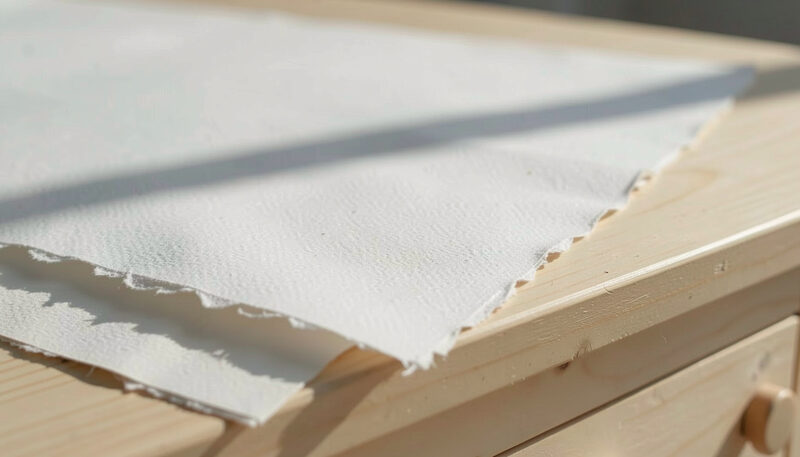
The edges of a sheet also say how it was made. Handmade paper has deckles, soft ragged edges, on all four sides. Mould-made paper comes off a cylinder mould machine with two natural deckles, formed where the papermakers tape the edge of the mould cover, and the other two edges are torn by hand, which is why mills describe the result either as two deckle and two torn edges or simply as four deckle edges. Arches lists its sheets with four deckle edges and its rolls with two, while its blocks and pads have cut edges.
Deckles matter at the moment of cutting. A painter cutting a full sheet into quarters decides whether each piece keeps a deckle as part of the finished picture or loses it to a clean trimmed edge, and that choice affects how the painting is later matted or framed.
What is watercolor paper called on the label?
A label packs several names into one line, and each answers a different question. The surface comes first: hot pressed, abbreviated HP, is smooth; cold pressed is a medium texture, called NOT in Britain, short for not hot pressed; rough is the most textured. Then comes the making: handmade, mould made, meaning formed on a cylinder mould machine, or machine made. Then the fiber, often 100 percent cotton; the sizing, internal or applied to the surface, sometimes with gelatine, which rules the paper out for anyone avoiding animal products; the weight in gsm and pounds; and the format, whether sheet, block, pad or roll.
Read in that order, a line such as "mould made, 100 percent cotton, NOT, 300 gsm, imperial" describes a sheet completely: a cotton paper formed on a cylinder machine, with a medium surface, of the familiar 140 lb weight, at 22 by 30 inches. Rolls stand outside the sheet sizes altogether. Arches sells its Aquarelle in rolls 113 or 130 centimeters wide and 10 yards long, for painters who want a format no sheet provides.
Cutting a full sheet down without waste
Buying full sheets and cutting them down lets a painter choose the format and keep one paper for every size of work. The method is simple. Fold the sheet in half across the long side, crease it firmly with a bone folder or the back of a spoon, and either tear along the fold against a steel straight edge or cut it with a sharp knife. Tearing leaves a soft edge close to a deckle; cutting leaves a clean one. Fold again for quarters, and again for eighths.
The pieces are then stored flat with the remaining full sheets, away from light and damp, each with its pencil mark on the back. A quarter sheet taped down for a wet-on-wet sky or a graded wash behaves exactly as the full sheet would, only in a format a beginner can finish in one sitting.
Questions painters ask about paper sizes
Is a half sheet of watercolor paper 15 by 22 inches?
Yes. A half sheet is an imperial sheet of 22 by 30 inches cut in half across its long side, which gives 15 by 22 inches, or about 380 by 560 millimeters. A quarter sheet, cut again, is 11 by 15 inches.
Does it matter which side of watercolor paper you use?
Both sides of a good artist paper can be painted. The felt side, packed uppermost by St Cuthberts Mill and on top in its pads and blocks, has the more random texture and is the face many artists prefer; the mould side can show a faint, regular pattern from the wire.
Is 140 lb watercolor paper the same as 300 gsm?
At imperial size, yes: a 300 gsm paper weighs 140 lb per ream of 500 sheets of 22 by 30 inches. Because the pound figure depends on sheet size, the gsm figure is the more reliable one when comparing papers.