Materials
A Student Watercolor Kit That Fits a Bag
What belongs in a first watercolor kit for a student, what it costs, and how to keep a painting habit going through a full term.
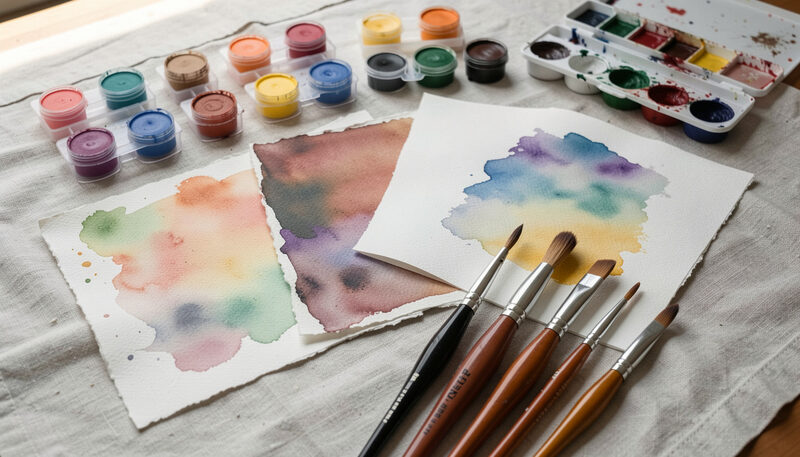
A first watercolor kit for a student fits in a bag when it stays small: a pocket palette of eight to twelve pans, two brushes, a pad of cold press paper around 140 lb, and a cloth. The whole thing costs roughly 40 to 90 US dollars if bought new, less if the palette and brushes are inherited. A habit survives a busy term when the kit is always packed, the session is short, and the subject is whatever is already on the desk.
What belongs in a first watercolor kit for a student?
The kit answers one question: can a painting happen in twenty minutes on a library table? Everything in the bag should serve that. A folding palette with eight to twelve half pans covers more ground than it looks. A warm and a cool version of each primary, plus a yellow ochre and a burnt sienna, mixes greens, greys and skin tones without a drawer of extras. Student-grade pans from a known maker are fine at this stage; the pigment load is lower, but the mixing behavior is honest.
Two brushes are enough. A size 8 or 10 round with a pointed tip carries a wash and draws a line. A flat, roughly half an inch, lifts color, makes edges and covers a sky quickly. Synthetic hair holds a point better than cheap natural hair and costs less. A short-handled travel brush fits a pencil case; a full-length brush is easier to control at a desk. Either works, but the brush should be one the painter does not worry about.
The paper matters more than the paint. A pad of 140 lb cold press, glued on two or four sides, keeps the sheet flat without stretching and takes a wash without buckling. A5 or A4 is the practical size for a bag; even A4 is smaller than a quarter sheet, the studio format at the modest end of the standard sizes of watercolor paper. Cotton paper behaves better, but a cellulose pad is a reasonable first purchase and a fair place to learn what sizing does. A small spray bottle, a rag, and a pencil complete the kit. A water container can be a jar from the kitchen.
Students who already run a weekly routine for coursework often find that the same logic applies to painting: a fixed slot, a small task, a place where the materials live. The note-taking and revision methods used for a term's reading can be borrowed for a sketchbook, with one page per session and a short review at the end of the week.
How much should a starter kit cost?
A realistic range is 40 to 90 US dollars for everything new, and 15 to 40 dollars if the palette and brushes are already in the house. The breakdown is not mysterious. A twelve-pan student palette runs about 12 to 25 dollars. Two synthetic brushes run 8 to 20 dollars together. A 140 lb cold press pad in A5 or A4 runs 10 to 25 dollars depending on sheet count and whether the paper contains cotton. A spray bottle and a rag come from a kitchen drawer.
Where the money goes wrong is usually the paint. A large set of thirty-six colors looks generous and mixes into mud, because half the pans are convenience greens and violets that no one needs. Eight to twelve well-chosen pans do more work. The same is true of paper: a cheap pad that buckles under a wet wash costs more in frustration than a slightly better pad costs in dollars. Buying one good block and cutting it down is often cheaper per painting than buying several thin pads.
A student budget can absorb this if the kit is bought once and replaced slowly. Pans last for months of regular use. Brushes last for years if they are rinsed and dried tip down. Paper is the only true consumable, and it is the line item worth watching. A single A5 sheet painted twice a week is roughly fifty sheets a term, which is one or two pads.
How do you keep a painting habit going during a busy term?
The habit survives on three rules: the kit stays packed, the session is short, and the subject is already in front of the painter. A packed kit removes the decision to start. A twenty-minute session fits between a lecture and dinner. A subject on the desk, a mug, a shoe, a window, removes the search for something worth painting.
A weekly slot works better than a daily intention. One hour on a fixed afternoon, protected the way a seminar is protected, produces more paintings than an ambitious plan that collapses in week three. The session can be split: ten minutes of drawing, thirty minutes of paint, ten minutes of looking at what happened. The last part is the one that teaches.
A small sketchbook with dated pages makes progress visible. Two or three lines about the light, the paper, or the mix are enough. Over a term, the pages show what changed. This is the same principle behind spaced review in any subject: short, repeated contact beats one long session, and the record of it is what makes the next session easier to start.
What does a twenty-minute session actually look like?
A twenty-minute session has a shape. The first two minutes are setup: water, palette, paper, brush. The next three are a pencil drawing, loose and small, no bigger than a postcard. Ten minutes are paint, one wash at a time, drying between passes with the back of the hand or a corner of the rag. The last five are cleanup and one note in the margin.
The subject should be simple enough to finish. A single object against a plain background teaches more than a complex scene abandoned halfway. A graded wash across a small rectangle teaches control of water. A sky with two clouds teaches edges. These are the same exercises that fill a beginner's term, and they fit in a bag.
Drying time is the constraint. On a 140 lb cold press sheet, a thin wash is touch-dry in a few minutes. A wet-on-wet passage takes longer. Working on two small sheets at once solves this: while one dries, the other is painted. This is a practical trick, not a technique, and it keeps a short session moving.
What should stay out of the bag?
Large palettes, full sheets, and a collection of specialty brushes stay home. A full sheet of 300 lb paper is a studio object, not a bag object. A mop brush, a rigger, and a set of half a dozen rounds are useful later, not in a first kit. Masking fluid, gouache, and metallic pans add decisions without adding skill at this stage.
A heavy water container is the most common mistake. A jar from the kitchen, a collapsible cup, or a bottle with a wide mouth weighs less and does the same job. A roll of paper towels is lighter than a stack of rags and can be torn down. The bag should close without effort; if it does not, something in it is not earning its place.
A weekly routine that survives a full timetable
The routine has four parts. First, a fixed slot of one hour, written into the week like a class. Second, a kit that lives in the bag, refilled the same evening it is used. Third, a subject list of five ordinary things, so the choice is already made. Fourth, a dated page and two lines of notes at the end.
A term has roughly twelve teaching weeks. At one session a week, that is twelve paintings, which is enough to see a change in handling water and paper. The point is not output. The point is that the kit is still in the bag in week ten, and that opening it takes no decision at all.
Costs stay predictable this way. One pad, one palette, two brushes, replaced only when worn. The kit is small, the sessions are short, and the habit is carried by the bag rather than by motivation. That is the whole method, and it fits a student timetable.