Painting Subjects
Sketchbooks and Painting Outdoors
Build a watercolor sketchbook habit and paint outdoors: a light kit, a small palette, working fast in changing light, and what to study from each sketch.
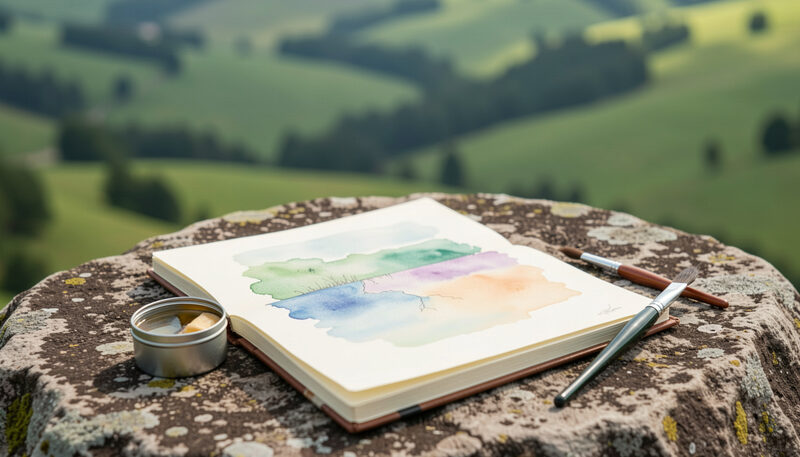
A sketchbook is the watercolor painter's workshop. It is where subjects are studied, where the behavior of the paper and the water is learned, and where the memory of a place is kept. Painting outdoors, on the spot, is the fastest way to improve, because it forces quick decisions and honest observation. This guide covers a light kit, a small palette, working fast in changing light, and how to turn a page of studies into a finished painting.
Why keep a sketchbook
A sketchbook turns painting into a habit rather than an event. Twenty minutes on a park bench, repeated often, teaches more about sky and trees than a whole afternoon copying photographs at home. The pages are allowed to be rough, which removes the pressure that stops beginners from starting. Over time the sketchbook becomes a record of how light and weather actually look, which is knowledge no book can supply.
A light outdoor kit
For painting on the spot, the kit should fit in one small bag. A cotton watercolor block or a hardbound sketchbook of watercolor paper, a travel brush or two, a water brush that carries water in the handle, a small palette of pans, a rag, and a light folding stool if the painter expects to stay. A bottle of water is useful but the water brush can replace it for small studies. Everything should be light, because a heavy kit stays at home and an unused kit teaches nothing.
A small palette
Outdoors, a small palette beats a large one. Eight to twelve pans, chosen as a warm and a cool of each primary plus two earths, cover almost any subject, and they force the painter to mix rather than to reach for a ready-made color. A folding tin with a mixing lid is ideal, because it holds the palette and the mixing area in one object. The pigment guide explains how to choose those twelve.
Working fast in changing light
Light changes while the painter works, so an outdoor study is a race against the clock. The discipline is to paint the big shapes first, sky, then land, then water, and to leave the detail until the end, if there is time. Fifteen minutes is enough for a small study if the painter commits to the first color and does not hesitate. The result will not be neat, but it will carry the light of that moment, which is what the study is for.
What to study from each sketch
After each study, look at it for a moment and name one thing that worked and one that did not. Perhaps the sky graded cleanly but the horizon was too dark; perhaps the tree shape read well but the water was overworked. Writing a short note beside the sketch, with the date and place, turns the page into a lesson. A sketchbook of annotated studies is worth more than a folder of unattributed paintings.
From sketch to studio painting
A sketch is not a finished picture but a set of decisions. Back in the studio, the painter uses it to plan a larger work: the composition is settled from the thumbnail, the colors are remembered from the study, and the technique is applied with the time that the studio allows. Working from a study rather than a photograph keeps the painting alive, because the study already contains the painter's judgment about what mattered. The technique guides supply the washes and glazing, and the water and sky guides show how the two most common subjects are handled.
Choosing a sketchbook
A sketchbook for watercolor needs paper that will take water without falling apart. A hardbound book of cotton or good wood-pulp paper, around 200 gsm or heavier, opens flat and survives a wet wash. A spiral or glued block is lighter but can warp unless the paper is heavy. The size matters as much as the paper: a book that fits a coat pocket will be carried, and a book that is carried is used. Choose one that opens flat, takes a wash, and is small enough to go everywhere, and keep it with a pencil and a small tin of paint so that a study can begin in a minute.
Sketching quickly and honestly
The value of an outdoor sketch comes from speed. Block in the big shapes in two or three tones, put down the light and the dark, and stop before the sketch becomes fussy. A sketch that takes ten minutes often teaches more than a careful drawing that takes an hour, because it records the painter's first, honest reading of the scene. If a shape is wrong, note it and move on rather than erasing; the next page will be better. Over time, this habit of quick, decisive studies feeds directly into confident studio paintings.
A weekly practice
The simplest plan is one study a week, of any subject, made outdoors if possible. Small, regular and unhurried, this practice builds both skill and confidence, and it keeps the eye sharp. The materials for it are modest, as the materials section explains, and the subjects are everywhere. A painter who keeps the habit for a year will be a different painter at the end of it.
Keeping the pages useful
A sketchbook becomes far more valuable if each page carries a little information beside the painting: the place, the date, the light, and a note of what was learned. Colors that worked can be jotted in the margin, and a failed passage can be marked with the reason. Months later, those notes are worth more than the sketches themselves, because they record not just what a place looked like but how the painter came to understand it. Treated this way, the sketchbook is not a collection of pictures but a working record, and it is the most useful tool a watercolor painter owns.
The sketchbook habit, once it settles in, tends to push a painter toward water itself: the flat grey of a pond at midday, the torn edge where a current crosses a stone, the way depth shifts from pale green shallows to a channel that reads almost black. A small outdoor study is the right place to notice these things without pressure. For painters who want to carry that attention further, the magazine's guide on water in a sketchbook and beyond it, into still and moving water, depth of colour, and the rite of immersion, follows the same thread from observation to painted surface.