Painting Subjects
Water in the Wash and Water in the Rite
Still water, moving water and the colour of depth in watercolor, set beside what Baptist churches mean by baptism by immersion and how a service unfolds.
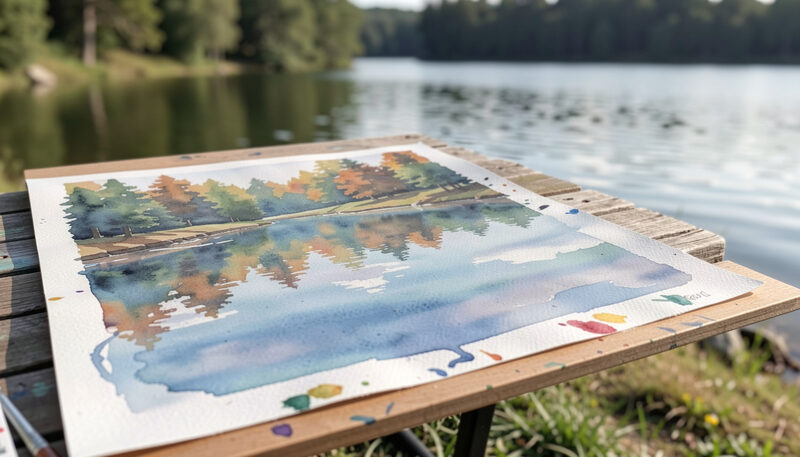
Water is the one material a watercolor painter never mixes on the palette. It is the medium, the solvent and, in most paintings, the subject. Baptist churches treat water the same way: not as decoration but as the substance of a rite, which is why immersion, not sprinkling, is the practice. The two habits of looking, one at a wash and one at a river, turn out to share a vocabulary of depth, movement and light.
What do Baptists believe about baptism and why do they immerse?
In Baptist teaching, baptism is an ordinance rather than a sacrament: an act of obedience performed by a believer who has already professed faith, not a ritual that confers grace on an infant. Because the candidate is old enough to answer for themselves, the congregation treats the moment as a public statement rather than a private one. Immersion follows from the plain reading of the Greek word behind the English term, which carries the sense of dipping or plunging, and from the symbolic logic of Romans 6, where burial with Christ and rising to new life are pictured in a single movement down and up.
The practical consequence is architectural. A Baptist meeting house needs a pool deep enough to stand in, usually set behind the pulpit wall, and a changing area on either side. The candidate enters by steps, the pastor takes a hand and a wrist, and the words spoken are short: a confession of faith, a pronouncement, and the descent. The baptist baptism by immersion explained in historical accounts of the tradition traces that practice back through the English Particular Baptists of the seventeenth century, and the reasoning has changed less than the buildings have.
For a painter, the scene is unusually generous. Water in a baptismal pool is still, dark and reflective, lit from above by a single fixture, and the figure entering it breaks the surface into concentric rings that spread and flatten within seconds. That is a wet-on-wet problem with a clock attached.
How is a Baptist worship service structured from opening hymn to benediction?
The order of service varies by congregation, but the shape is remarkably consistent across the tradition. A typical Sunday morning runs roughly ninety minutes and moves through four movements: gathering, proclamation, response and sending.
The gathering opens with a voluntary on the organ or piano, a call to worship read from the front, and a hymn sung by the congregation standing. Announcements follow, then an offertory, then the pastoral prayer. The proclamation section is the longest: a scripture reading, a second hymn, and the sermon, usually twenty-five to thirty-five minutes. The response may include an invitation to come forward, a period of silence, or a closing hymn. The sending is the benediction, a short scriptural blessing spoken over the congregation, after which people leave in no particular order.
Baptism, when it occurs, is normally placed between the sermon and the closing hymn, so that the congregation witnesses the act and responds to it in the same service. Communion in Baptist churches is usually observed monthly rather than weekly, and it is open to any baptized believer rather than restricted to members of that congregation.
What is the difference between American Baptist Churches USA and Southern Baptists?
Both bodies descend from the same nineteenth-century Baptist movement in the United States, but they separated in 1845 over slavery and have diverged on governance and theology since. The Southern Baptist Convention is the larger body, organized as a convention of cooperating churches with a strong central structure for missions and seminaries. American Baptist Churches USA is smaller, historically rooted in the northern states, and organized around regional bodies that retain considerable autonomy.
The practical differences show up in congregational life. American Baptist churches tend to ordain women and to take a more congregational approach to local decisions; Southern Baptist churches have moved toward a stricter statement of faith and a more centralized expectation of what churches teach. Polity matters more than most visitors expect: in both bodies the local congregation owns its building and calls its own pastor, which is why two Baptist churches on the same street can differ on nearly everything except the mode of baptism.
Still water, moving water and the colour of depth
Still water is a mirror with a memory. A lake at dawn reflects the sky almost perfectly, which means the painter is not painting water at all but painting the sky twice, once directly and once inverted and slightly darkened. The trick is to keep the reflection softer than the source: a wash laid over damp paper, lifted at the edges with a thirsty brush, will read as water; a hard-edged reflection will read as glass.
Moving water is a record of time. A stream is not a shape but a set of intervals, and the painter who tries to draw every ripple produces a diagram rather than a river. The useful approach is to paint the stones and the banks first, then drag a loaded brush across the dry paper in the direction of flow, leaving the white of the sheet as foam. Speed of stroke matters more than accuracy of outline.
Depth is a colour problem, not a value problem. Shallow water over pale sand reads as ochre and raw sienna; deeper water shifts toward viridian, then toward indigo, and the shift is caused by light being absorbed rather than by anything in the water itself. A single wash of phthalo blue over a warm underpainting will produce a depth that no amount of layering grey can imitate. The same principle governs the baptismal pool: the water is clear, the tile beneath it is not, and the colour the congregation sees is a collaboration between the two.
Painting a baptismal pool without sentimentality
The temptation is to paint the moment rather than the place, and the moment resists painting. A better subject is the pool itself on a weekday, empty, with the light on and the water flat. The geometry is simple: a rectangle of dark water, a tiled step, a handrail, a wall of pale brick. The interest is in the reflection of the ceiling fixture and the faint green cast where the water meets the tile.
If a figure is included, keep it small and keep it still. The pastor's arm and the candidate's hand are the only two points of contact, and they should be the darkest marks in the painting. Everything else, the water, the wall, the light, stays quiet. The result is a painting about a place where something happens, which is usually more durable than a painting about the thing happening.
Where the two habits of looking meet
A painter learns to read water by asking three questions: what is it reflecting, what is it hiding, and how fast is it moving. A congregation reading the same water in a baptismal pool asks a fourth: what is it saying. The answers do not compete. One is a description of light, the other a description of meaning, and both depend on the same observation, that water is never only itself. It is always the colour of what lies beneath it and the shape of what passes over it, which is why it has held the attention of painters and preachers for the same two thousand years.
Water rewards patience, but it also asks a question that a single study cannot answer: what happens when the same washes must carry a story across many pages, at a size a child holds in two hands? The pacing, the palette that stays readable at a small trim size, and the revision passes such a project needs are the subject of a separate guide, Watercolor Picture Books: Spreads, Palette, Revisions, which takes the watercolour skills practiced here and applies them to watercolor for a picture book. Painters who have just learned to keep a wash clean will find the next set of decisions waiting there.