Technique
A Ten-Minute Daily Watercolor Drill
A ten-minute daily watercolor drill that trains accuracy before speed: one repeated wash, warm-up strokes, and a desk set so brush, board and eye sit right.
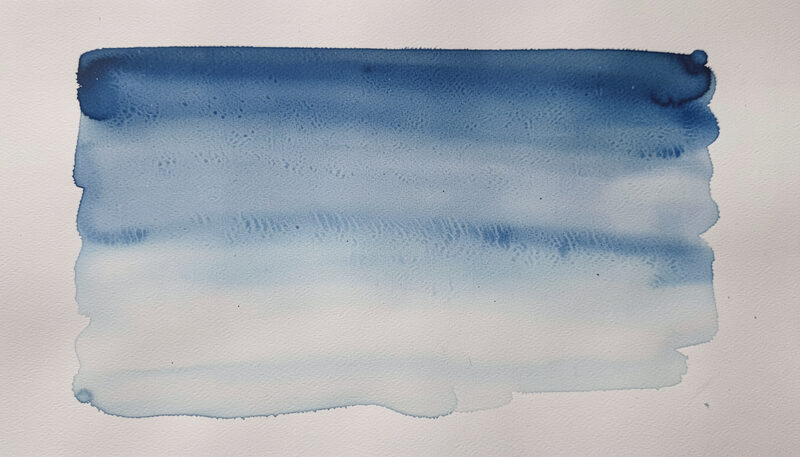
Ten minutes a day, one wash repeated, is enough to train the hand for accuracy before speed. The session has a fixed shape: two minutes of warm-up strokes, five minutes on a single wash, two minutes of marks placed with intent, one minute to stop. Speed is not the goal and is not measured; the goal is a clean edge, an even value and a hand that arrives where the eye intended.
The same logic governs any skill built on repeated small movements, which is why the practice structure described at typing practice for beginners transfers so directly: short sessions, accuracy first, speed as a by-product. A watercolorist who borrows that discipline finds the ten minutes easier to keep than an occasional long afternoon.
What should a ten-minute daily practice session contain?
A ten-minute session holds four parts, in this order.
Warm-up strokes, two minutes. Load the brush once and draw a series of parallel lines across a scrap of the same paper used for finished work. Vary only the pressure: light, medium, light. The purpose is to wake the wrist and to check how much water the brush is actually carrying today, which changes with humidity and with the age of the paper.
The day's wash, five minutes. One wash only, repeated. A graded sky, a single flat panel, a soft edge meeting a hard one. The wash is chosen in advance and does not change during the week. Repetition is the point: the hand learns a specific movement rather than a general idea of painting.
Placed marks, two minutes. Three or four strokes that must land in a chosen spot: a stem, a roof line, the dark under a stone. These are accuracy exercises, not drawing. The eye picks the target, the hand commits once, and the result is judged only on whether the mark landed where it was aimed.
Stop, one minute. Rinse the brush, wipe the palette, leave the board set for tomorrow. A session that ends in tidying is a session that starts on time the next day.
How do you train accuracy before speed?
Accuracy is trained by removing speed from the equation entirely. In a ten-minute drill the brush moves slowly enough that the hand can feel the paper under it, and the measure of success is placement, not pace.
Three habits do most of the work. First, one stroke per decision: the brush touches the paper once, travels, and lifts. Hesitation in the middle of a stroke shows as a wobble that no amount of later correction removes. Second, a fixed starting point. If every graded wash begins at the same margin and travels the same direction, the hand builds a reliable path and the eye learns to predict the result. Third, a narrow target. Aim for a two-centimeter band rather than a vague area; a small, checkable goal teaches more than a large, forgiving one.
Speed arrives on its own once the movement is reliable. A painter who can lay a clean graded wash slowly will lay it faster within weeks, because the unnecessary motions have dropped away. Trying to paint fast before the movement is stable produces exactly the marks that are hardest to fix: dry streaks, hard unintended edges, blooms where the water pooled.
How should the desk, the board and the chair be set up?
The setup matters more than most painters expect, because a ten-minute session leaves no time to compensate for a bad arrangement.
The board sits at a shallow angle, roughly fifteen to twenty degrees, propped on a block or a purpose-made easel. A flat board makes the wash run toward the painter; a steep board makes it run away too fast. The shallow tilt lets gravity help the wash spread evenly without taking over.
The paper is taped on all four sides. Loose paper shifts under the brush, and a shifting sheet destroys the accuracy the drill is meant to build.
The chair height is set so the forearm rests level with the board, elbow just below the wrist. If the elbow is below the board, the hand has to reach up and the wrist tenses. If it is above, the shoulder takes the load and the strokes shorten.
The palette sits to the side of the dominant hand, within reach without turning the head. Water jars go on the opposite side, so the brush crosses the paper rather than the palette when it is rinsed.
The eye should be able to move from the mixing area to the paper without refocusing on a different distance. A lamp placed to the side, not behind the hand, keeps the paper free of the painter's own shadow.
How do short breaks against fatigue work?
Fatigue in watercolor shows up first as a loss of control at the end of a stroke, not as tiredness in the arm. The last centimeter of a line starts to wander, and the wash pools where it should thin.
Short breaks work because they interrupt the accumulation of small errors. A ten-minute session already contains a natural pause: the change from warm-up to the day's wash. Standing up for thirty seconds between the wash and the placed marks resets the shoulder and the grip.
For longer sessions, the same principle applies at a larger scale. Twenty minutes of painting followed by two or three minutes away from the board keeps the hand fresh enough to hold the accuracy that was trained in the first place. The break is not a reward; it is part of the drill.
A useful check is to compare the first and last stroke of a session. If the last is visibly worse, the session ran too long or the breaks were too few. If the two are close, the ten minutes were well spent.
Why one wash a day, and not a finished painting
A finished painting asks too many questions at once: composition, color, value, edges, and the movement of the hand. A single wash asks one question, and answers it in five minutes.
Choosing the wash in advance removes the daily decision. A week of graded skies, then a week of flat panels, then a week of soft edges meeting hard ones. Each week the hand learns a movement it can then use without thinking.
The drill is deliberately small. Ten minutes is short enough to survive a busy day and long enough to change a habit. The measure of progress is not a finished sheet but a steadier hand, a cleaner edge, and a mark that lands where the eye intended.
A daily drill only holds if the materials are within reach when the day gets crowded. Ten minutes of washes and edges beats an hour postponed to a weekend that never arrives, and the setup matters as much as the practice: a small palette, two brushes, a pad that tolerates water. For readers assembling that setup for the first time, the magazine's guide to a kit for a student bag lists what the whole thing costs and how a weekly routine survives a full timetable. Start with the drill, then let the kit follow the habit rather than the other way around.